When something goes wrong in an industrial system, the first question is usually simple:
What happened?
The answer is often much harder to find.
A pump may stop unexpectedly. A valve may open at the wrong time. A controller may issue an unusual command. A sensor may report impossible values. A remote site may lose communication just before an alarm.
In many cases, operators are left with only partial information. They may know the final outcome, but not the exact sequence of messages, commands and responses that led to it.
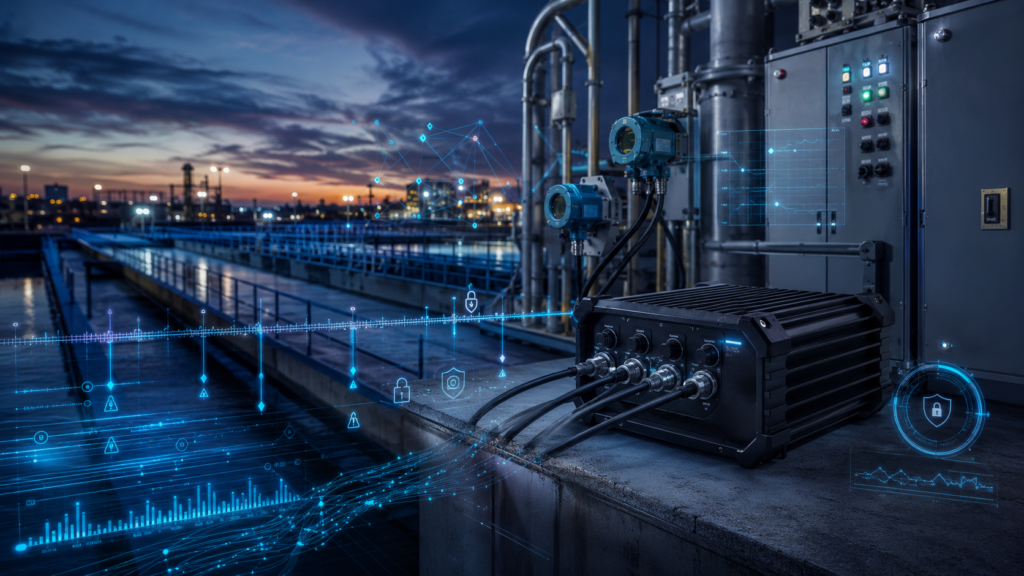
This is why industrial systems increasingly need the equivalent of a flight recorder: a dedicated mechanism that continuously records operational communication so that events can be reconstructed later.
In Operational Technology, this concept is often described as an OT black box.
Why Industrial Incidents Are Difficult to Reconstruct
Industrial systems are built around real-time communication.
Sensors send values. Controllers issue commands. Devices respond. Alarms are triggered. Operators acknowledge them. Each event may happen within milliseconds.
Much of this communication is transient.
Once a command has been sent, it may not be stored anywhere. A controller may update its internal state without keeping a detailed history. An HMI may record the final alarm but not the raw exchange that caused it.
By the time an engineer begins investigating, the most important evidence may already be gone.
This creates a serious problem.
Without a reliable record, teams may be forced to rely on memory, incomplete logs or assumptions. That can lead to incorrect conclusions and repeated failures.
What an OT Black Box Records
An OT black box continuously captures communication between field devices, controllers, gateways and supervisory systems.
The exact data depends on the architecture, but it may include:
- Raw protocol frames
- Commands sent to field equipment
- Device responses
- Sensor values
- Alarm messages
- Communication errors
- Connection and disconnection events
- Timestamps
- Device identities
- Operator actions
- Changes in system state
The goal is not simply to store every dashboard value.
It is to preserve the underlying sequence of communication in enough detail to understand what happened later.
This raw evidence is especially important because higher-level systems often summarize or transform industrial data. A dashboard may show that a motor stopped, while the communication record reveals whether it stopped because of a local fault, a remote command, a communication timeout or a protective shutdown.
Incident Reconstruction
The most obvious benefit of continuous recording is incident reconstruction.
After a failure, investigators can replay the sequence of events and determine how the system behaved.
They may be able to answer questions such as:
- Which device sent the first abnormal message?
- Was the command valid?
- Did the controller respond correctly?
- Did a communication delay contribute to the problem?
- Was the alarm generated before or after the failure?
- Did an operator action affect the outcome?
- Were sensor readings already unusual before the incident?
This can be invaluable after mechanical failures, production interruptions or cybersecurity events.
Instead of guessing, investigators can build a timeline based on recorded evidence.
Mechanical Failure or Cyber Event?
One of the hardest problems in OT is distinguishing between an ordinary equipment failure and malicious activity.
A pump may stop because of overheating, a damaged cable, a controller fault or an unauthorized command. A sensor may produce abnormal data because it is failing or because the message has been manipulated.
The symptoms can look similar.
A detailed communication record helps separate these possibilities.
If a legitimate controller issued the stop command after receiving a valid high-temperature reading, the event may be mechanical or operational.
If the command came from an unknown source or was issued without the expected process conditions, the incident may require a cybersecurity investigation.
Forensic evidence allows teams to evaluate what actually occurred instead of classifying every anomaly as either a technical failure or an attack too early.
Operational Investigation
Forensics is not only useful after a major incident.
Recorded communication can also support routine operational analysis.
Engineers may use historical records to study:
- Intermittent equipment faults
- Repeated communication failures
- Performance degradation
- Timing problems
- Unexpected control sequences
- Differences between similar sites
- Conditions leading up to alarms
- Sensor behaviour over long periods
Many industrial problems are difficult to reproduce.
A device may fail once every few weeks. A communication timeout may occur only under a specific load. A sensor may briefly report an invalid value and return to normal before anyone sees it.
Continuous recording ensures that these short-lived events are not lost.
The Importance of Raw Data
Processed data is useful for operators, but raw data is often more useful for investigators.
A monitoring platform may convert a protocol message into a simple value such as “pressure: 7.3 bar.” That is clear and easy to display.
However, the original frame may contain additional information, including addressing, timing, status bits, error codes or unusual formatting.
If the system stores only the processed value, that context disappears.
Raw communication records preserve the original evidence.
This allows protocol specialists and forensic investigators to inspect exactly what was transmitted without relying entirely on the interpretation performed by another system.
Time Synchronization Matters
A forensic record is only useful if events can be placed in the correct order.
Accurate timestamps are therefore critical.
Industrial networks often contain multiple devices, each with its own clock. If those clocks are not synchronized, two systems may record the same incident at different times.
This can make it difficult to determine which event came first.
A strong forensic architecture should use reliable time synchronization and record timestamps with enough precision for the application.
The faster the process, the more important this becomes.
In some systems, seconds are sufficient. In others, investigators may need millisecond-level accuracy.
Protecting the Evidence
Forensic data must itself be protected.
If an attacker can modify or delete the record, the system cannot be trusted as evidence.
The recording architecture should therefore support measures such as:
- Restricted access
- Tamper detection
- Cryptographic integrity checks
- Write-once or append-only storage
- Secure backups
- Independent retention
- Audit logs for access and export
- Protection from ordinary operator accounts
Ideally, the recorder should be separated from the systems being monitored.
If the same compromised controller can erase its own history, the value of the record is greatly reduced.
The strongest designs make deletion or alteration difficult, visible or both.
Forensic Readiness
Forensic readiness means preparing to investigate before an incident occurs.
Many organizations wait until after a breach or major failure to discover that the necessary logs were never collected.
By then, it is too late.
A forensic-ready industrial environment defines in advance:
- What communication should be recorded
- How long records should be retained
- Who may access them
- How timestamps are synchronized
- How integrity is verified
- How evidence is exported
- How investigations are documented
- How storage capacity is managed
This preparation reduces confusion during an incident and improves the reliability of the investigation.
Supporting Regulatory Compliance
Industrial operators are increasingly expected to demonstrate accountability.
Depending on the sector and jurisdiction, organizations may need to maintain logs, investigate incidents and show how critical systems were operated.
A continuous communication record can support these obligations by providing an auditable history.
It may help demonstrate:
- When an event occurred
- Which device was involved
- What commands were issued
- How the system responded
- Whether alarms were generated
- Whether operators took action
- Whether security controls functioned as expected
This does not automatically guarantee compliance, but it provides the evidence needed to support reporting and review.
Improving Future Security
A forensic system is not only about explaining the past.
It can also improve future resilience.
After an incident, teams can analyze the record and determine which controls failed, which warnings were missed and which design changes are needed.
They may update alarm thresholds, improve network segmentation, replace unreliable equipment or change how commands are authorized.
Without evidence, corrective action is often based on speculation.
With a detailed record, improvements can be targeted at the actual cause.
Storage and Retention Challenges
Continuous industrial recording can generate large amounts of data.
Organizations must decide how much to retain and at what level of detail.
Not every deployment needs to store every frame forever.
A practical strategy may combine:
- High-resolution recent data
- Longer-term summarized data
- Extended retention around alarms
- Automatic marking of significant events
- Compression
- Site-based retention policies
- Secure archiving for major incidents
The design should balance forensic value, storage cost and operational need.
Data should not be collected without a clear purpose, but critical evidence should not be discarded too quickly.
The Black Box as Part of System Design
An OT black box should not be treated as an afterthought.
It should be considered during system architecture, alongside communication security, HMI design, alarms and device management.
The recorder must be able to observe the relevant traffic without interfering with normal operations. It should remain reliable during failures and preserve evidence even when other parts of the system are compromised.
This requires careful placement and clear operational procedures.
Knowing What Really Happened
Industrial systems are too complex to rely on memory and incomplete logs.
When a serious failure or cyber incident occurs, organizations need more than the final alarm. They need the sequence of communication that produced it.
A dedicated OT black box provides that record.
It supports incident reconstruction, operational analysis, regulatory accountability and long-term security improvement.
Most importantly, it replaces uncertainty with evidence.
In industrial operations, that can be the difference between fixing the real problem and waiting for it to happen again.