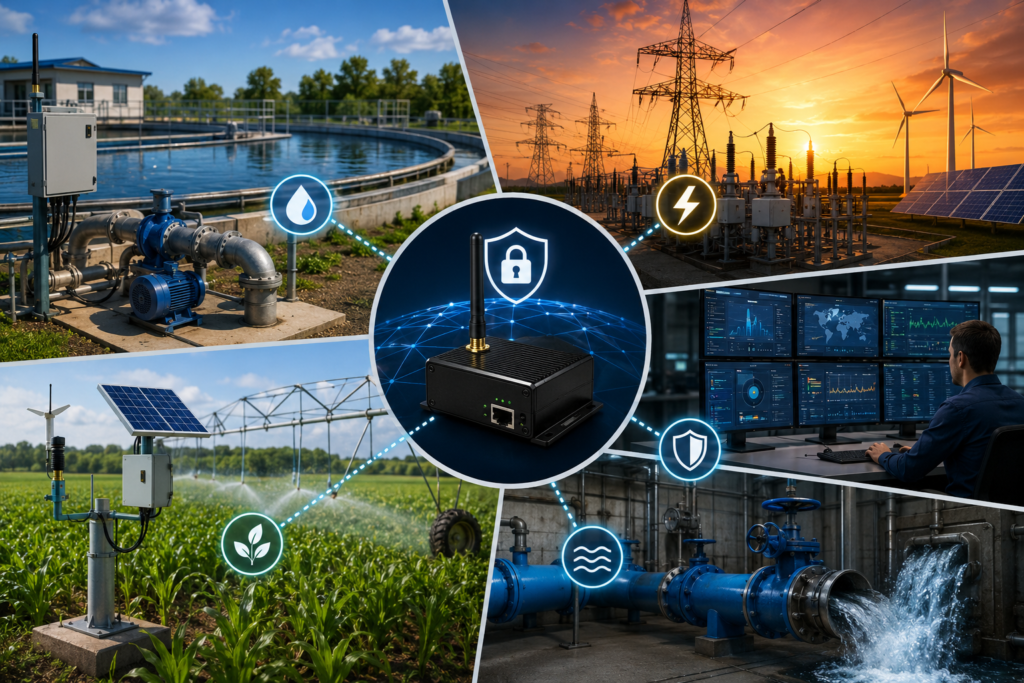
Some industrial systems are important because they improve efficiency.
Others are important because daily life depends on them.
Water systems, energy networks, pumping stations, remote reservoirs, substations, and essential perimeter facilities belong to the second category. These are lifeline systems. When they fail, the consequences are immediate. Service may be disrupted, safety may be affected, and communities may lose access to necessities.
As these sectors become more connected, the challenge is no longer simply how to monitor them. The challenge is how to monitor them securely, reliably and in a way that does not create new vulnerabilities in the process.
That is especially important because the systems that keep water flowing and lights on are now recognized as high-value targets for cyberattacks.
Why Lifeline Infrastructure Is Different
Critical infrastructure is not like an ordinary IT environment.
A failure in a business application may cause inconvenience or lost revenue. A failure in a water pumping station may affect drinking water, wastewater treatment or irrigation. A failure in an electrical system may interrupt power to homes, industry, healthcare facilities or communications.
These systems also tend to be geographically distributed.
A utility may operate dozens or hundreds of remote sites. Some may be in urban facilities. Others may be in isolated rural areas, along pipelines, near reservoirs, inside agricultural zones or at unmanned substations. Sending staff physically to each site for routine status checks is expensive and slow.
Remote visibility is therefore essential.
Operators need to know when a tank level changes unexpectedly, when a pump stops running, when pressure drops, when a site loses power or when a perimeter alarm is triggered.
But these systems also face a serious constraint: they cannot safely expose core operational equipment directly to the internet.
The Water Sector: Visibility Without Exposing Control Systems
Water infrastructure is one of the clearest examples of this challenge.
Water utilities rely on a wide range of distributed assets, including:
- Pumping stations
- Reservoirs
- Booster stations
- Irrigation systems
- Flow-measurement sites
- Pressure-monitoring points
- Treatment-related remote assets
These sites often need only a few core pieces of information to support daily operations: water level, pressure, flow rate, pump state, power condition and alarm status.
Much of this information comes from well-established industrial instrumentation, including 4–20mA analog sensors.
A current loop signal can represent a measured variable such as:
- Tank or reservoir level
- Flow rate
- Pressure
- Temperature
- Chemical dosing level
- Valve or actuator position
A secure remote monitoring system can collect these values and send them to a central platform without requiring the field control system to accept incoming internet traffic.
That distinction matters.
Operators gain awareness of what is happening at the site, but the pump controller or local automation system is not turned into a remotely reachable target.
Threshold Alarms and Fast Response
Monitoring becomes especially valuable when it supports immediate response.
A water-level reading that drops below an acceptable minimum may indicate a leak, supply interruption or pump failure. A flow rate that rises unexpectedly may indicate a burst pipe or unauthorized use. Pressure that falls outside its expected range may point to equipment problems or network instability.
A good monitoring architecture allows thresholds to be defined in advance.
When a measured value crosses one of those thresholds, the system can generate an alert automatically. That alert may be delivered through a dashboard, event log, notification system or cellular messaging channel depending on the operational design.
The point is not simply to collect data for historical reporting. It is to reduce the time between the beginning of a problem and the moment someone becomes aware of it.
In lifeline infrastructure, response time matters.
A problem detected early may be fixed before it becomes a service outage.
Why Authentic Alerts Matter
In critical infrastructure, it is not enough for alerts to arrive quickly. They also need to be trustworthy.
If a utility receives a low-level alarm, it must know that the message truly came from the correct field device and that it was not forged, altered or replayed by an attacker.
False alerts waste time and can train staff to ignore real warnings. Worse, fabricated data may cause operators to make the wrong decision at the wrong time.
This is why strong message validation matters in industrial monitoring.
A secure system should be able to verify that incoming telemetry or alarms came from a known device using a trusted identity. It should also be able to detect whether messages have been altered or whether an unknown source is attempting to inject false information.
For utilities, this means an alarm is more than just a notification. It is evidence from a verified source.
That level of trust is essential when operators are making decisions that affect public infrastructure.
Energy Systems and Distributed Operations
Many of the same principles apply in the energy sector.
Power infrastructure is often highly distributed and may include:
- Remote substations
- Switchgear sites
- Generator systems
- Solar and storage installations
- Fuel and gas support systems
- Utility control enclosures
- Monitoring points across transmission or distribution networks
These sites require dependable communication and timely alarms, but the core protection systems and operational controllers should not be exposed unnecessarily.
Secure monitoring can help operators identify issues such as:
- Equipment overheating
- Cabinet intrusion
- Power loss
- Abnormal current or voltage conditions
- Generator status changes
- Fuel or pressure anomalies
- Site communication failure
Again, the purpose is to improve visibility while preserving strong separation between monitoring and operational control where possible.
The more distributed the network, the more valuable this becomes.
Without remote awareness, operators may discover problems only after a site has failed or customers have already been affected.
Perimeter Security and Remote Facilities
The same secure connectivity model can also support remote perimeter and facility protection.
Some critical sites require monitoring not only of process data, but also of security-related signals such as door contacts, cabinet intrusion, motion detection or environmental alarms.
Remote facilities may be lightly staffed or completely unmanned. In those environments, trustworthy alarming is essential.
A secure industrial monitoring architecture can collect these signals and report them centrally without requiring an open inbound path into the protected site.
That reduces exposure while improving awareness of physical and environmental events.
For high-security sites, the value is clear: early warning, central visibility and less dependence on vulnerable remote-access methods.
The Importance of Local Independence
Even the best remote monitoring system should not replace local safety and control.
A pumping station should still protect itself locally. A power-related site should still rely on its own protection logic. A remote facility should continue to function safely even if connectivity is temporarily lost.
This is one of the strengths of a well-designed architecture.
The field equipment continues to do its job locally. The monitoring layer provides awareness, alarming and operational insight. The two functions support one another without being unnecessarily merged.
This reduces the risk that a communications issue becomes an operational failure.
It also helps ensure that remote visibility does not come at the cost of local resilience.
Keeping Critical Services Running
The practical value of secure industrial connectivity is easiest to understand in the sectors people depend on most.
When a reservoir begins to empty unexpectedly, operators need to know. When a pump fails, they need an alert. When a remote power site loses communication or reports abnormal conditions, that information needs to be trusted and acted on quickly.
These are not convenience features. They are part of maintaining essential services.
The safest modern infrastructure is not infrastructure that remains blind. It is infrastructure that can be seen clearly without being unnecessarily exposed.
For water, energy and other critical systems, secure remote monitoring helps operators do exactly that: maintain awareness, respond faster and protect the services communities rely on every day.