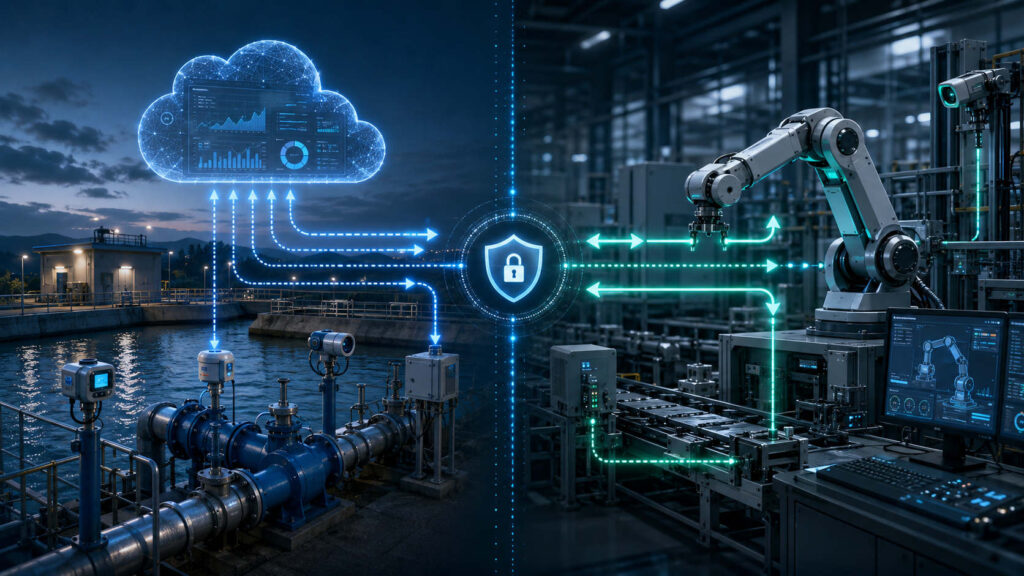
Not every industrial system needs the same type of connectivity.
Some sites only need to report information. Others must receive commands, respond in real time or support continuous interaction between operators and remote equipment. Treating these very different requirements as though they were identical can lead to unnecessary complexity, excessive exposure or an architecture that is poorly matched to the actual mission.
The first question in any industrial connectivity project should therefore be simple:
Does the remote site need to be monitored, or does it also need to be controlled?
That distinction should determine the communication architecture from the beginning.
When Monitoring Is Enough
Many remote industrial applications are fundamentally observational.
A water utility may need to know the level of a reservoir. A facility manager may want to monitor pump status. An agricultural operator may need readings from pressure, flow or soil sensors. An energy provider may want alerts when equipment exceeds a defined temperature.
In these situations, the field system needs to send information outward, but it does not necessarily need to accept remote commands.
A monitoring-only architecture can collect sensor readings, alarms, status changes and diagnostic information, then transmit that data to a central platform. Operators can view the results through dashboards, reports or an HMI without establishing a general-purpose remote-access path back into the field network.
This approach reduces exposure because the field device does not need to listen for unsolicited connections. It initiates communication when data is available, when a threshold is crossed or according to a predefined schedule.
For many critical infrastructure applications, this is not a limitation. It is a deliberate security boundary.
If no operational requirement exists for remote control, adding two-way communication creates capability without providing meaningful value. That additional capability must then be configured, authenticated, monitored and defended for the lifetime of the system.
The Security Value of One-Way Operational Flow
A monitoring-only architecture follows the principle of minimum necessary functionality.
The system can report what is happening without allowing an external party to directly alter what is happening.
This can be especially important in environments where accidental or malicious commands could cause physical consequences. A remote instruction might start a pump, stop ventilation, open a valve or change the operating state of machinery.
Where those actions are unnecessary, preventing remote commands entirely removes a significant category of risk.
This does not mean the system lacks intelligence. The field equipment may still contain local automation, threshold logic and safety controls. A programmable controller can continue to operate the process independently.
The communication layer simply remains focused on reporting information rather than participating in control.
When Two-Way Communication Is Necessary
Other systems genuinely require full duplex communication.
Full duplex means that data can travel in both directions, often simultaneously. The remote system sends telemetry and operational status while also receiving commands, configuration changes or control instructions.
This capability may be necessary for:
- Remote robotic or mobile platforms
- Command-and-control systems
- Interactive industrial machinery
- Real-time equipment operation
- Remote configuration and maintenance
- Applications requiring immediate operator intervention
In these environments, monitoring alone is not sufficient. The ability to send commands is part of the operational purpose of the system.
The security goal is therefore not to eliminate two-way communication, but to control it rigorously.
Two-Way Does Not Mean Open Access
A common mistake is to assume that a duplex system must be broadly reachable from the internet.
It should not be.
Secure two-way communication should be limited to specific, authorized endpoints. The field device should only connect to predefined servers and should reject communication from unknown destinations.
This creates a closed communication relationship rather than a general remote-access service.
Strong mutual authentication is essential. The field device must verify the server before accepting commands, and the server must verify the identity of the device before exchanging data.
Encryption protects the content of the session, while authentication determines whether the participants are legitimate.
These are different functions, and both are required.
An encrypted command from an unauthorized server is still an unauthorized command.
Protecting Device Identity
In a secure duplex environment, device identity must be difficult to copy.
Each unit should have a unique cryptographic identity rather than relying on a shared password or common key. This allows the server to distinguish between individual devices and reject hardware that has not been registered.
The strongest implementations protect cryptographic keys inside a secure hardware element or similarly isolated component.
The private key remains protected and is used internally to prove the device’s identity. It is not simply stored as a file that can be copied onto another machine.
This helps prevent an attacker from cloning a legitimate device or introducing unauthorized hardware into the network.
Secure SIM technology can also support this model by placing cryptographic material inside a protected component associated with the device’s cellular identity. The exact implementation may vary, but the underlying principle remains the same: device identity should be rooted in protected hardware rather than easily copied software credentials.
Designing Around the Mission
The correct architecture depends on the operational requirement.
A reservoir-level monitor and a remotely operated robotic platform should not be designed in the same way. The first may need to send a few readings and alarms. The second may require continuous low-latency communication in both directions.
Applying a duplex architecture to a simple monitoring system may expose unnecessary functionality. Applying a monitoring-only architecture to a control system may make the system unusable.
The decision should be made by examining several questions:
Does the remote site need to receive operational commands?
How quickly must an operator be able to influence the process?
Can local automation handle normal operation without remote intervention?
What are the physical consequences of an unauthorized command?
Which servers are permitted to communicate with the field equipment?
How will device and server identities be verified?
These questions help define the minimum safe communication model.
Local Control Versus Remote Control
Remote connectivity should not automatically replace local control.
Even when two-way communication is available, industrial equipment should retain appropriate local safety mechanisms. Connectivity can fail. Cellular service may be interrupted. A server may become unavailable.
Critical processes should not depend entirely on a continuous cloud connection unless the application has been specifically engineered for that dependency.
Local controllers should continue to enforce safety limits and predictable fallback behaviour. Remote commands should operate within those limits rather than bypassing them.
This layered approach ensures that communication supports the industrial process without becoming its single point of failure.
Security Through Appropriate Capability
The safest industrial communication system is not always the one with the most features. It is the one whose capabilities closely match the mission.
Monitoring-only systems benefit from a restricted outbound model that limits remote exposure. Interactive systems require secure two-way communication, but access should be confined to authenticated devices, authorized servers and explicitly permitted operations.
The critical design choice is not simply whether a system can communicate in both directions.
It is whether it needs to.
By answering that question early, organizations can avoid unnecessary attack surfaces while still providing the visibility or control required for effective industrial operations.